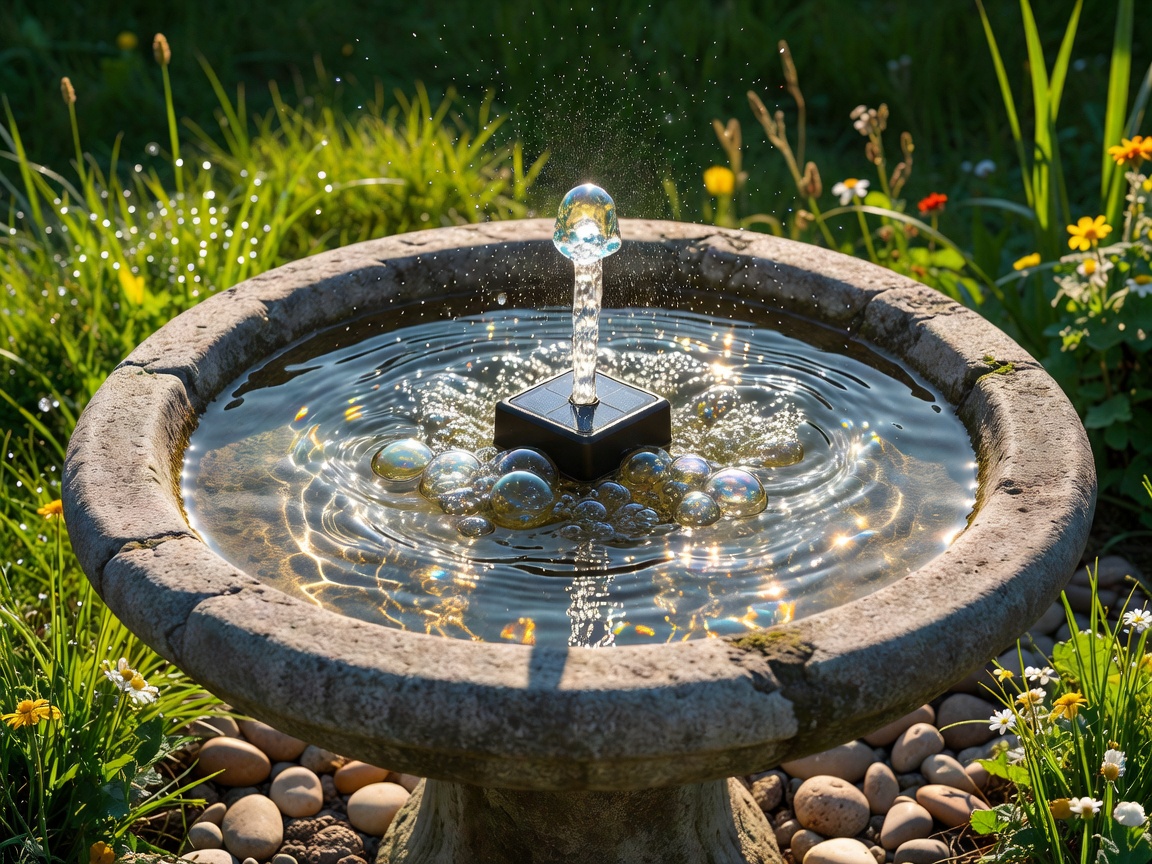
The Cordless Water Feature Revolution
For decades, installing an outdoor fountain meant either placing it right next to the house or paying an electrician to run underground conduit across the lawn. Solar-powered fountains have revolutionized landscape design by offering complete placement freedom. Because they draw energy entirely from photovoltaic panels, you can position a solar fountain in the middle of a vast lawn, on a remote retaining wall, or at the edge of a property without worrying about extension cords.
How Solar Fountains Work
The mechanics are straightforward: a small, specialized solar panel absorbs sunlight and converts it into direct current (DC) electricity. This electricity flows via a low-voltage wire to a submersible DC water pump situated in the fountain basin. When the sun hits the panel, the pump activates, pushing water through the fountainhead.
Direct Solar vs. Battery Backup
When shopping for a solar fountain, the most critical decision you will make is choosing between a "direct solar" model and one with "battery backup".
- Direct Solar (On-Demand): These units only operate when direct sunlight is hitting the panel. If a cloud passes over, or a shadow from a tree covers the panel, the fountain stops immediately. They are highly reliable due to having fewer electronic components, but their performance is strictly tied to real-time weather conditions.
- Solar with Battery Backup: These units feature a rechargeable battery pack (usually lithium-ion or NiMH) wired into the system. During sunny periods, the solar panel simultaneously runs the pump and charges the battery. When clouds roll in, or the sun sets, the battery kicks in, allowing the fountain to run for an additional 2 to 6 hours into the evening.
Optimizing Solar Panel Placement
The success of a solar fountain hinges entirely on panel placement. A solar panel cannot simply be placed in bright ambient light; it requires direct, unshaded sunlight hitting the photovoltaic cells to generate enough power for a water pump.
Many solar fountains come with the panel built directly into the basin (integral panels). While convenient, these require the entire fountain to be placed in full sun. Other models feature an external panel attached via a 10 to 15-foot cable. The external panel allows you to place the fountain itself in a shady, relaxing spot while staking the panel a few yards away in the bright sunshine.
For maximum efficiency, the panel should be angled directly toward the midday sun (typically facing South in the Northern Hemisphere) and kept free of dust, pollen, and debris.
Pros and Cons of Solar Fountains
| Advantages | Limitations |
|---|---|
| Zero operating costs on your electricity bill | Performance drops significantly on overcast days |
| Eco-friendly, renewable energy usage | Pumps are generally lower volume/pressure than AC models |
| No need for outdoor GFCI outlets or trenching | Integral panels limit where the fountain can be placed |
| Safe, low-voltage wiring limits electrical hazards | Battery packs have a lifespan of 1-3 years before replacement |
Maintenance for Solar Models
Maintaining a solar fountain is similar to standard AC fountains, with a few critical additions. The solar panel itself must be wiped clean with a damp microfiber cloth every few weeks; a layer of dust or bird droppings can dramatically reduce electrical output. Furthermore, because solar pumps are typically smaller and less powerful than AC pumps, they are more susceptible to clogging. You must frequently check the pump's intake screen and clear away leaves, algae, or pet hair to prevent the motor from burning out.